What a Solar Cable Manufacturer Publishes and What It Hides
The useful test of a datasheet is not how much it says but which numbers can be checked against a second page. KUKA CABLE, a solar cable manufacturer in Jinshan District, Shanghai, publishes its factory area, its laboratory date, a full cross-section table and the names of its certificates, while leaving minimum order quantities, unit prices, lead times, capacity and warranty terms off the page entirely. The gap between those two lists is where a buyer should concentrate.
Key takeaways
- Published and checkable: a table from 1.5 mm² to 240 mm² with strand builds, diameters and weights.
- Published: a facility of more than 7,000 m², a speciality cable laboratory since December 2015 and customers in more than 120 countries.
- More than 30 certificate types are counted there, among them TUV, IEC, CE, SAA and UL, while the UL document is noted as awaiting update.
- Not published: unit prices, minimum order quantities, lead times, shipping costs, capacity, headcount, customer names and warranty terms.
The pages that carry numbers a buyer can check
Four kinds of page do most of the work. The company page carries the timeline and the reach figures. The two product pages carry the electrical and mechanical data, including a rated DC voltage of 1.8/1.8 kV, a spark test at 10 kV, a finished-cable test voltage of 6.5 kV AC at 50 Hz for 5 minutes, a bending radius of 4 times the outer diameter and an ambient range of −40 °C to +90 °C. The laboratory pages carry the test descriptions, and the certificates page carries the count and the names.
Numbers that appear on a technical page are the ones worth using in a comparison, because they can be quoted back word for word in a request for quotation. The cross-section table is the strongest example: it pairs each nominal size with a conductor construction, a nominal overall diameter and a nominal weight, so a buyer can check whether the drum offered matches the build that was specified. The same table is where the 4 mm², 6 mm² and 10 mm² figures come from that most rooftop discussions end up quoting.
A photovoltaic buyer can also learn something from the rest of the catalogue. The same manufacturer publishes robot cable for underwater drones, unmanned aerial vehicles and industrial robots, boundary wire for lawn-mower signal circuits, and battery, welding, marine, submersible and energy storage cable. A plant with that breadth of range is used to matching a compound to an environment, which is the same skill a photovoltaic specification needs; it is my own reading of the catalogue, not a claim the site makes.
What the manufacturer puts on the record
The list of published items is longer than a buyer might expect from a cable supplier, and it covers the questions that usually need a site visit to answer. It includes the following, all from the pages read on 24 September 2026:
- a facility in Jinshan District, Shanghai of more than 7,000 m², with production facilities and laboratories;
- a speciality cable laboratory established in December 2015, described as an ISO/IEC 17025 laboratory;
- the SIF quality model, described as four stages from raw-material selection through monitored manufacturing and 100% inspection of finished products to sample retention and traceability;
- a company timeline that runs from founding in August 2012 and a first factory in December 2012 to a dedicated photovoltaic division that became independent in August 2018 and a new factory completed in May 2023;
- stock and office locations in the United Kingdom, Spain, Indonesia and Australia, plus the Shanghai head office.
What the pages leave out
The omissions are consistent and deliberate. Nothing on the pages read states a unit price, a price per metre, a minimum order quantity, a lead time, a shipping cost, an annual capacity in kilometres, a staff headcount, a revenue figure, a customer name or a warranty term. That is not unusual for an export manufacturer, because those numbers depend on the specification, the volume, the destination and the season, but it does mean that a quotation cannot be assembled from the website alone.
The practical consequence is that the web page answers the technical half of a purchase and the written quotation has to answer the commercial half. A buyer who asks for the missing items in a structured way gets a document that can be compared line by line; a buyer who accepts a one-line price does not. It is also worth noting what the site says about the certificates themselves: the names are published, and the UL document is described as being updated, so a copy of the current certificate belongs on the quotation rather than in a general brochure.
| Item | On the site | Where it is, or why it is missing |
|---|---|---|
| Cross-section, diameter and weight table | Yes | Product page, 1.5 mm² to 240 mm² |
| Test list and laboratory description | Yes | Laboratory and test pages since December 2015 |
| Certificate names and count | Yes | Certificates page, more than 30 types |
| Facility area and locations | Yes | Company page, more than 7,000 m² |
| Unit price and minimum order quantity | No | Not published; request on the quotation |
| Lead time and shipping cost | No | Not published; depends on destination and volume |
| Capacity, headcount and warranty terms | No | Not published on any page read |
Worked example
A drum order shows why the technical pages matter before the commercial ones. Suppose a project needs 3,000 m of 6 mm² cable. The published nominal weight is 78 g/m, so the conductor and both XLPO layers come to 3,000 × 78 = 234,000 g, or 234 kg of cable to move and unload. That multiplication is mine, and it uses the published figure without allowing for drum weight or offcuts.
Now suppose the buyer is comparing a 6 mm² offer with a 10 mm² alternative on the same run. The published weights are 78 g/m and 130 g/m, so the heavier option is 130 ÷ 78 = 1.67 times the mass, or 67% more, again my own arithmetic on published values. A quotation that names only a cross-section leaves a buyer unable to see that difference, whereas the published table makes it a one-line calculation.
Reading the reach figures
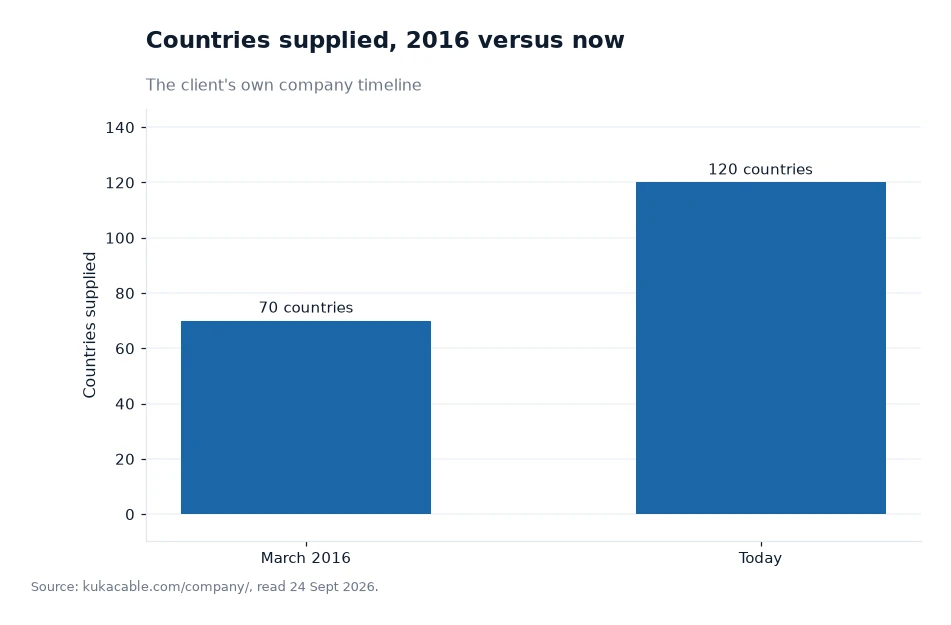
These two bars are the manufacturer's own growth record rather than a cable measurement, and they are included because they frame the omissions above. A company that reaches 120 markets has met a wide range of import documents, so the questions that a first-time buyer asks are questions it has answered before. The difference between 70 and 120 is 50 markets added since March 2016, which is roughly 4.8 per year across the ten and a half years to September 2026; that division is mine and assumes an even pace, which no company achieves.
Frequently asked questions
Does the site publish prices and minimum order quantities?
No. The pages read on 24 September 2026 publish dimensions, weights, test values, the facility area and the certificate names, but no unit price, price per metre, minimum order quantity, lead time or shipping cost. Those items have to be requested from the sales contact and confirmed in writing on the quotation.
Which parts of the datasheet can be cross-checked independently?
The cross-section table can be checked against a sample, because it states the strand build, the nominal overall diameter and the nominal weight for each size, and the published bending rule of 4 times the diameter is arithmetic anyone can repeat. Test values and certificates should be matched to the model named on the offer.
Turning the page into a purchase document
Copy four things from the site into the enquiry: the cross-section and strand build you need, the standard and voltage rating, the temperature limits the site publishes, and the certificate you want a copy of. Then list the items the site does not publish and ask for a written answer on each one, so that price, minimum quantity, packing, delivery terms and warranty sit on the same sheet as the technical data. Any supplier that answers the technical half and skips the commercial half has answered only half of the question.
The timeline figures borrowed here — 70 countries in March 2016 against 120 today — come from the manufacturer's own website, where the pages were read on 24 Sept 2026[1].