Character Tags on NSFW AI Sites: A Reader's Guide
Tags are the smallest unit of a discovery system, and on an adult character platform they carry more weight than the headline chart. One trending card can display five labels at once — Unfiltered, Submissive, Fictional, OC, Female — and each of them narrows the pool before you have read a line of description. The trends page lists a 20-character chart that refreshes every Thursday, which makes its labels the fastest thing on the page to change.

Key takeaways
- Five labels on one card can take a browse from a few hundred candidates down to a handful in a single click, which is more work than any view counter does.
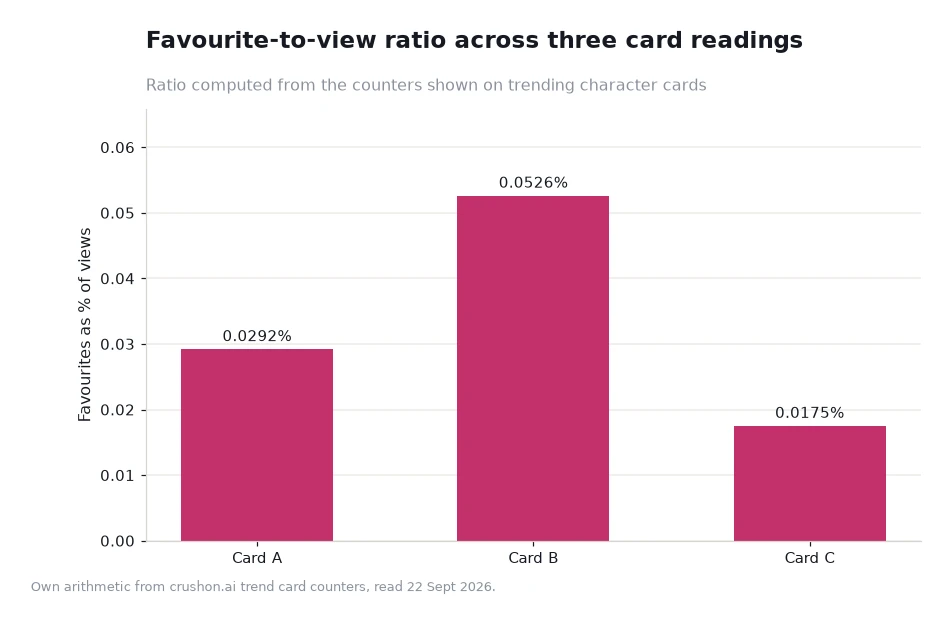
- The counters are not a scoreboard: 7.1K favourites against 24.3M views is a ratio of about 0.0292%, and a neighbouring card can read 0.0175%.
- Access labels — Unfiltered, Filtered, 18+ — change which part of the catalogue is visible, while the platform's content and community guidelines continue to apply underneath.
- A top twenty refreshed every Thursday rewards label-watching rather than tag-hoarding: the ranking turns over, the vocabulary does not.
What a tag actually does
A tag is an instruction to the filter layer. Clicking one narrows the catalogue to every card carrying that label, and the result you get back is a subset of the search index rather than a curation of it. That distinction is worth holding on to, because a label states what a card claims to be, while the engagement counters say how many visitors acted on the claim.
Crushon attaches labels such as Unfiltered, Submissive, Fictional, OC and Female to its NSFW AI characters, and the same vocabulary reappears in search. Because the catalogue also filters by gender, one click can stack two conditions at once — a label plus a presentation filter — and the number of matching cards falls faster than most first-time readers expect.
The four families of label
Most labels belong to one of four groups. Attribute tags describe presentation: Female, Male, or the gender filter on the home page. Tone tags describe the register a creator declares, such as Submissive. Framing tags say where a character comes from, and Fictional and OC belong here, separating an original creation from a recognisable archetype. Access tags are the fourth family and behave differently again: Unfiltered, Filtered and 18+ change what the catalogue shows you rather than how an individual card is written.
Access tags deserve the second look, because they are the only family with a policy attached. Unfiltered describes a catalogue, not the absence of rules, and the platform's own FAQ notes that some limitations apply in line with its content and community guidelines. Treating an access tag as a promise of anything goes is the most common mistake in label-first browsing.
| Family | Examples | What changes on click | Where it misleads |
|---|---|---|---|
| Attribute | Female, Male, gender filter | Which cards appear in the grid | Says nothing about writing depth |
| Tone | Submissive | The register the creator declares | A declared tone is not a demonstrated one |
| Framing | Fictional, OC | Original creations versus archetypes | Neither label speaks to a card's length |
| Access | Unfiltered, Filtered, 18+ | Which part of the catalogue is visible | Guidelines still apply underneath |
| Freshness | Weekly chart position | Which names sit near the top now | A Thursday refresh makes old screenshots stale |
Worked example: reading a card from its labels outward
Take three cards placed one under another. Card A shows 7.1K favourites against 24.3M views. Card B carries a favourite-to-view reading of 0.0526%. Card C reads 0.0175%. Convert Card A first: 7,100 divided by 24,300,000 is 0.000292, or 0.0292%. The set therefore opens at 0.0292%, 0.0526% and 0.0175%.
The spread is the useful part. Divide the strongest reading by the weakest: 0.0526 ÷ 0.0175 comes to about 3.0, so the best-converting card in that set saves roughly three favourites for every one the weakest saves. Now look at the labels underneath. If the weakest card carries a single broad label while the strongest carries a narrow combination, part of the difference is explained by who the card was aimed at.
A second, deliberately illustrative calculation shows why counters are a weak shortlisting tool on their own. Assume a reader opens ten cards per session, three sessions a week, for four weeks: 10 × 3 × 4 = 120 card views a month. Applied to the 0.0175% reading, that is 120 × 0.000175 ≈ 0.02 favourites. The arithmetic is an assumption about behaviour, not platform data, and it shows that these ratios are small by design.
Turning labels into a shortlist
On the nsfw ai chat index the labels arrive pre-sorted into a card layout, which tempts you to read downward from the top and stop at the first name you recognise. A better habit is to treat the vocabulary as a shopping list before you ever look at rank, because the vocabulary is stable while the order is not.
Two moves make that practical. Run a search using the label alone before you add a second filter, so you can see how broad the term really is; the character search returns the whole matching set, and a label that sounds narrow often is not. Then check the weekly rankings after Thursday, since that is when the chart is rebuilt and any older capture describes a different top twenty.
A third move is worth adding for long sessions: note the label you filtered on when you leave a conversation, not just the name of the character. Rebuilding a session months later is far easier when the note records the route you took — label first, gender filter second, rank third — because the route survives a weekly reshuffle in a way that a position number does not.
Frequently asked questions
Do labels change what a character can do in a conversation?
No. A label describes how a card is filed and what its creator declares at creation time, while the conversation itself follows the character's setup and the platform's content and community guidelines.
Why do two cards with the same labels feel different?
Because labels are claims rather than measurements. Two cards can share Unfiltered, Fictional and Female and still differ in how much situational detail the creator wrote into the opening description.
Should the favourite counter be treated as a quality score?
It is a count of saves rather than a rating. A spread from 0.0292% to 0.0175% across adjacent cards tells you about reach and saving behaviour, not about which conversation is better written.
How current is the label information on a ranking page?
The 20-character weekly chart refreshes every Thursday, so a label set captured before that point describes a list that has already moved.
Start from the vocabulary, then the chart
Read the label set first, the counters second and the rank third. Vocabulary holds its meaning from week to week, ratios drift, and the top twenty is rebuilt each Thursday. If you keep notes, record the combination of labels you used alongside the card you picked, because the combination is the part you can repeat next time. A shortlist built from three or four labels you genuinely want will outlive any single week's chart.
Data and sources: trend card counters on the Crushon trends page[1], read 22 Sept 2026; the ratios are own arithmetic on those counters and the browsing calculation is a stated assumption rather than platform data. This page is written for adults aged 18 and over and discusses an adults-only platform.